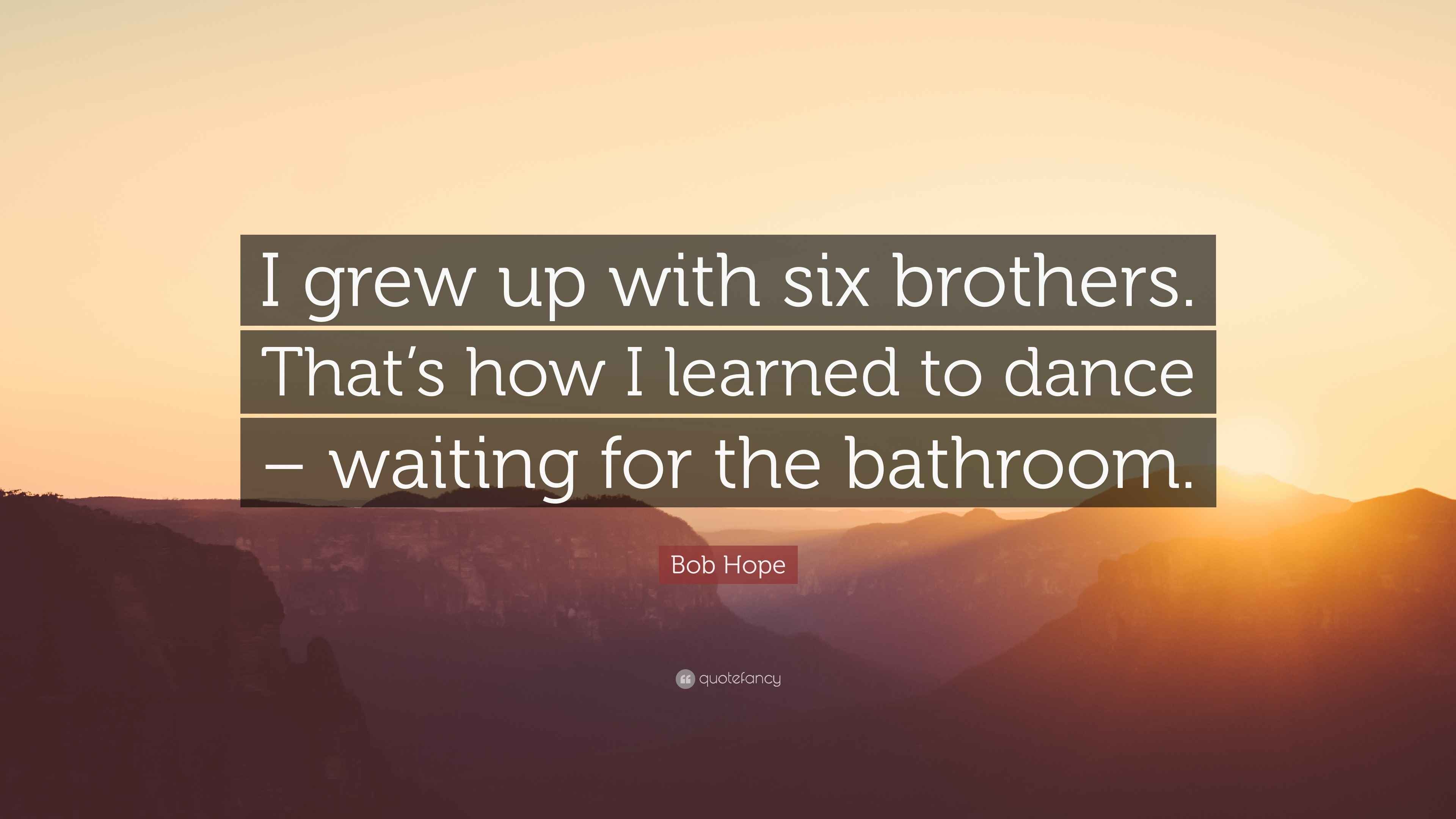
Growing up in a crowded household doesn’t just teach you how to share a bathroom—it teaches you how to survive. Bob Hope once said, “I grew up with six brothers. That’s how I learned to dance—waiting for the bathroom.” On the surface, it’s a classic one-liner, the kind of punchline that made him a household name across generations. But peel back the laughter, and you’ll find a deeper truth about relationships, resilience, and the absurd beauty of growing older in a world that never stops moving.
That single quote—often shared as a simple “quote of the day”—carries layers. It’s not just about humor. It’s about how early experiences shape who we become, how family dynamics influence our emotional intelligence, and how laughter can be a survival tool in both youth and age. This is the real legacy of Bob Hope: not just the punchlines, but the life lessons hidden behind them.
Let’s break down what this quote—and the man behind it—can teach us about navigating love, aging, and even politics with grace and wit.
The Hidden Wisdom in a Simple Joke
Bob Hope’s quote is deceptively simple. He grew up with six brothers. Seven boys in one house. Chaos. Competition. Constant negotiation. But instead of complaining, he reframed it as a dance—elegant, rhythmic, almost graceful. “That’s how I learned to dance—waiting for the bathroom.”
This isn’t just wordplay. It’s philosophy disguised as comedy.
Think about it: waiting for the bathroom in a house full of brothers requires timing, patience, strategy—and a sense of humor. It’s a microcosm of life. Every interaction becomes a small negotiation. Every shared space, a potential conflict. And in that pressure cooker, Hope developed emotional agility.
Real-life application: Many people in large families report developing sharper social awareness early on. They learn to read rooms, anticipate reactions, and diffuse tension—skills that serve them well in relationships and careers. Hope turned necessity into art.
But more than that, he turned struggle into humor. That’s the lesson: when you can’t change the situation, change the story you tell about it.
Family as the First Relationship Teacher
Hope’s experience wasn’t unique—many of us grew up in crowded homes, with siblings who were equal parts rival and ally. But what sets his perspective apart is how he used those early dynamics to inform his worldview.
Having six brothers meant constant exposure to: - Competition for attention - Shared routines under strain - Conflict resolution (or avoidance) - The politics of favoritism - The humor of shared suffering
These aren’t just sibling stories—they’re the foundation of all human relationships.
Example: Imagine a couple arguing over chores. The tension isn’t really about the dishes; it’s about fairness, recognition, and respect. Someone who grew up navigating six brothers likely has a built-in radar for these undercurrents. They know how to step back, lighten the mood, or find compromise—often with a joke.
Hope’s humor was rarely just for laughs. It was a tool for disarming tension. In relationships—romantic, familial, professional—this skill is invaluable.

Common mistake: Many people treat humor as avoidance. They joke to deflect real issues. But Hope’s humor was different. It didn’t replace honesty—it paved the way for it. A well-timed quip could open a conversation that might otherwise stay closed.
Aging with Grace: What Hope Knew Early
Bob Hope lived to be 100. He performed well into his 90s. And throughout his life, he maintained a sharp, self-deprecating wit about aging. But his ability to age with grace didn’t come from genetics—it came from practice.
Living with six brothers taught him early that life is about adaptation. You don’t get the first pick. You wait. You adjust. You find your rhythm.
That same mindset served him in old age.
Practical insight: Aging brings its own version of the “bathroom line.” You wait for test results. You wait for responses. You wait for your body to cooperate. The dance changes, but the rhythm remains.
Hope never resisted aging—he commented on it. He joked about memory loss, mobility, and relevance. But beneath the jokes was a quiet acceptance. He wasn’t afraid to be vulnerable, because he’d spent a lifetime learning how to share space—physical, emotional, and social.
Workflow tip: Use humor as a resilience tool. When facing age-related challenges—slower recovery, shifting roles, loss of independence—reframe the struggle with lightness. Not to deny pain, but to reduce its weight.
Hope didn’t pretend aging was easy. He just refused to let it steal his voice.
Humor as Political Survival
Hope wasn’t just a comedian—he was a political commentator in disguise. For decades, he performed for U.S. troops overseas, often during war. His USO tours were legendary. And his monologues? Razor-sharp, full of jokes about presidents, policy, and patriotism.
But he never alienated. Even when roasting a sitting president, he did it with a wink—never a sneer.
Why it worked: Because his humor came from a place of shared experience. He didn’t position himself above the audience. He positioned himself beside them—another guy who’d waited too long for the bathroom, another American who’d seen the system work (and fail).
In today’s polarized climate, that’s a rare skill.
Realistic use case: Imagine discussing politics at a family dinner. Tensions rise. Voices lift. Instead of escalating, someone says, “Well, at least we’re not fighting over the last towel in a house of seven boys.” The room laughs. The tension breaks. The conversation continues—more calmly.
That’s Bob Hope’s legacy: using humor not to win arguments, but to preserve connection.
He understood that comedy, at its best, is empathy in disguise.
The Dance of Daily Life: Waiting, Timing, and Patience
Let’s return to the metaphor: dancing while waiting.
It’s poetic, but it’s also practical. Life isn’t about constant motion. It’s about rhythm. Timing. Knowing when to move—and when to wait.
Hope’s “dance” wasn’t choreographed. It was improvised. It was born of necessity. That’s what makes it so relatable.
Examples in modern life: - Waiting for a promotion while delivering value quietly - Navigating a breakup with dignity - Parenting through the chaos of young children - Building a career in a saturated market
In all these cases, you’re not always in control. But you can control your attitude. Your timing. Your ability to stay light on your feet.
Hope’s life was a masterclass in this kind of emotional agility. He didn’t just survive Hollywood’s golden age—he thrived in it, through shifts in media, culture, and taste. How? By staying nimble. By keeping the rhythm.
Why This Quote Still Resonates Today
We share “quote of the day” posts for a reason. They offer quick wisdom in a noisy world. But most fade instantly. Hope’s quote sticks because it’s universal, layered, and human.
It speaks to: - The chaos of family - The humor of shared struggle - The grace of patience - The resilience of growing older
And it does so without pretense. No lofty language. No fake positivity. Just a man who knew what it was like to wait—and turned that wait into art.
Limitation to consider: Not everyone finds humor natural. Some people see joking as avoidance or insensitivity. The key is intent. Hope’s humor wasn’t about masking pain—it was about making room for it, then lightening the load.
If you force humor where it doesn’t belong, it backfires. But when it’s authentic, it connects.
Bob Hope’s Legacy: More Than a One-Liner
Behind every great comedian is a lifetime of observation. Bob Hope didn’t just tell jokes—he studied people. And his quote about six brothers isn’t just a laugh. It’s a lens.
It teaches us that: - Family shapes emotional intelligence - Humor is a form of strength - Aging doesn’t have to mean decline - Politics doesn’t have to mean division
And above all: life is easier when you can laugh while you wait.
We can’t all grow up with six brothers. But we can all learn to dance in the line.
Final Thought: Make Your Wait Meaningful
Next time you’re stuck—waiting for a reply, a promotion, a breakthrough—ask yourself: How can I dance while I wait?
Not by ignoring the frustration. Not by faking positivity. But by finding the rhythm in the delay. By using the time to observe, adapt, and prepare.
That’s what Bob Hope did. And that’s why, decades later, we’re still listening.
FAQ
What did Bob Hope mean by “I learned to dance waiting for the bathroom”? He used humor to describe the chaos of growing up with six brothers, highlighting how shared spaces and constant negotiation taught him timing, patience, and resilience.
How did Bob Hope’s family life influence his comedy? Living in a crowded household sharpened his observational skills and taught him how to navigate conflict with humor—traits that defined his comedic style.
Did Bob Hope talk about aging in his performances? Yes, he frequently joked about aging, retirement, and memory loss, using self-deprecating humor to connect with older audiences and ease the stigma around growing older.
Was Bob Hope involved in politics? He was politically active through his USO tours and public commentary, often joking about presidents and policy, but always with a tone of patriotism and unity.
What can modern audiences learn from Bob Hope’s humor? His comedy teaches emotional resilience, the power of timing, and how to use humor to build connection—not to attack, but to include.
Is the “six brothers” quote real? Yes, it’s a well-documented quote attributed to Bob Hope, often cited in biographies and retrospectives about his life and career.
How can I apply Bob Hope’s mindset to daily stress? Reframe challenges with lightness. Use humor to reduce tension, practice patience, and find rhythm in the chaos—just like dancing while you wait.
FAQ
What should you look for in Bob Hope’s Life Lessons: Humor, Family, and Wisdom? Focus on relevance, practical value, and how well the solution matches real user intent.
Is Bob Hope’s Life Lessons: Humor, Family, and Wisdom suitable for beginners? That depends on the workflow, but a clear step-by-step approach usually makes it easier to start.
How do you compare options around Bob Hope’s Life Lessons: Humor, Family, and Wisdom? Compare features, trust signals, limitations, pricing, and ease of implementation.
What mistakes should you avoid? Avoid generic choices, weak validation, and decisions based only on marketing claims.
What is the next best step? Shortlist the most relevant options, validate them quickly, and refine from real-world results.